

By March 2029, every publicly trusted TLS certificate will expire in 47 days or less. Right now it's still 398. That eightfold cut in renewal cycles is the newest pressure on public key infrastructure (PKI), the system that already authenticates most of the traffic, devices, and code running in production today.
Public key infrastructure (PKI) is the system of certificate authorities, policies, and cryptographic keys that proves a server, device, or person is who it claims to be online. It issues, validates, and revokes the digital certificates behind HTTPS, VPN access, code signing, and machine-to-machine authentication. Every TLS padlock in a browser traces back to a PKI trust chain.
Key takeaways
- PKI is the framework of certificate authorities, certificates, and cryptographic keys that establishes trust between machines, servers, and people online.
- The CA/Browser Forum's Ballot SC-081v3 cuts maximum TLS certificate validity from 398 days to 47 days between March 2026 and March 2029.
- Machine identities already outnumber human identities 109 to 1 across the organizations Palo Alto Networks surveyed for its 2026 Identity Security Landscape report.
- NIST finalized production-ready post-quantum cryptography standards in August 2024; PKI's algorithm-agile design is what lets an organization migrate without rebuilding trust from scratch.
What is PKI?
Public key infrastructure (PKI) is the framework of policies, roles, and technology that issues, validates, and revokes the digital certificates binding a public key to a verified identity. It lets a browser trust a website, a device authenticate to a network, or one server verify another, without either side sharing a secret in advance.
Shared-secret trust doesn't scale past a handful of systems. A password or an API key proves identity only to whoever already holds a copy of it, and every new system that needs to verify that identity needs its own copy, its own storage, and its own rotation schedule. PKI solves this with asymmetric key pairs: a public key anyone can have, and a private key only the owner holds. A certificate authority (CA) vouches for the binding between the two once, and every relying party trusts that one signature instead of managing its own secret with every counterparty.
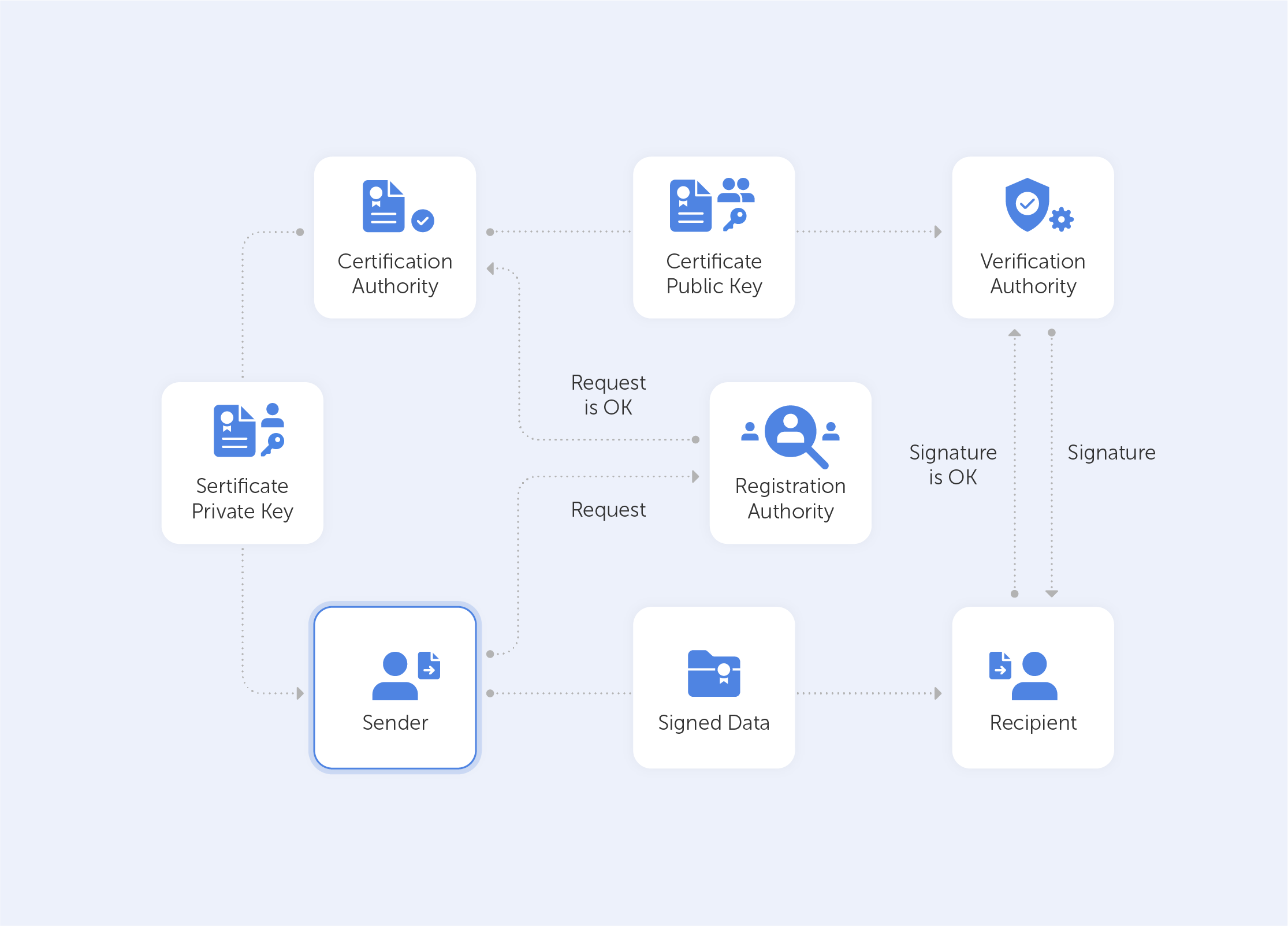
A digital certificate is a cryptographically bound, time-limited identity claim that a CA has vouched for, not a password substitute. Its trust rests on math a private key can prove, not on the certificate itself staying secret.
How does PKI work?
PKI works by pairing a public key with a private key through asymmetric encryption. The private key stays with its owner and signs or decrypts; the public key is published inside a certificate, so anyone can verify that signature or encrypt something only the owner can read. A certificate authority validates the pairing before issuing the certificate.
The certificate lifecycle runs through five stages:
- Key pair generation: a device or user generates a public/private key pair locally. The private key never leaves that device unencrypted.
- Certificate signing request (CSR): the applicant packages the public key and identity details into a CSR and sends it to a CA or registration authority.
- CA validation and issuance: the CA verifies that the requester controls the domain, device, or identity claimed, then signs a certificate binding that public key to the verified identity.
- Certificate use: the certificate authenticates the server or device and secures the session, usually via TLS, or signs data such as code or email.
- Renewal or revocation: the certificate is renewed before it expires, or revoked early through a certificate revocation list or OCSP responder if the private key is compromised or the identity changes.
In practice, TLS combines both encryption types rather than relying on asymmetric cryptography alone. Asymmetric keys are computationally expensive, so a TLS handshake uses them only to authenticate the server and negotiate a shared symmetric session key; the rest of the connection runs on faster symmetric encryption. For the full handshake sequence, see how TLS works.
The core components of a PKI
A PKI has six moving parts: the certificate authority that issues trust, the registration authority that verifies identity, the database and revocation list that track certificate status, the policy that sets the rules, and the hardware security module that protects the CA's private key. Remove any one and the trust chain breaks in a specific, predictable way.
| Component | Role | What breaks without it |
|---|---|---|
| Certificate authority (CA) | Issues and signs certificates; the trust anchor | No trust anchor; nothing left to validate against |
| Registration authority (RA) | Verifies identity before the CA issues | Certificates get issued without confirming who actually requested them |
| Certificate database | Stores issued certificates and their metadata | No record of what was issued, to whom, or when |
| Certificate revocation list (CRL) | Publishes revoked certificates before they expire | A compromised certificate stays trusted until it naturally expires |
| Certificate policy | Defines validation rules and certificate classes | Inconsistent issuance standards across the CA |
| Hardware security module (HSM) | Stores and uses the CA's private key without exposing it | Root key exposure compromises every certificate the CA ever issued |
PKI trust models: Public, private, and hybrid
PKI runs on two trust models. Public, or Web, PKI is governed by the CA/Browser Forum and issues the certificates browsers trust by default for public websites and services. Private PKI is an organization's own CA hierarchy, trusted only inside that organization, for internal servers, IoT fleets, and VPNs. Most enterprises run both.
| Model | Governed by | Typical use | Typical certificate lifetime |
|---|---|---|---|
| Public / Web PKI | CA/Browser Forum, public CAs | Public websites, APIs, email | Falling to 47 days by 2029 |
| Private / internal PKI | The organization's own CA policy | Internal servers, IoT devices, VPN, mTLS | Set by internal policy, often one to two years |
Within either model, certificates chain up through a hierarchy: a root CA signs intermediate CAs, which sign the certificates end systems actually use. Larger organizations sometimes bridge two hierarchies together, or run a mesh where multiple CAs cross-certify each other, but a straightforward hierarchical chain covers most deployments.
What is PKI used for?
PKI secures HTTPS traffic, authenticates VPN and Wi-Fi clients, signs code and documents, encrypts email through S/MIME, and establishes device identity for IoT fleets and service meshes. Wherever two systems need to verify each other's identity before exchanging data, a certificate is usually doing that work.
- HTTPS/TLS for websites and APIs: the certificate behind the padlock, encrypting the session and authenticating the server.
- Email encryption and signing (S/MIME): proves a message came from the stated sender and wasn't altered in transit.
- Code signing: verifies that software or a driver hasn't been tampered with since the publisher signed it.
- VPN and Wi-Fi authentication: device or user certificates replace or supplement shared network passwords.
- IoT device identity: each device gets its own certificate instead of a shared credential baked into firmware.
- Containerized workloads and service mesh (mTLS): services authenticate each other before any traffic flows, at machine speed.
Why PKI is harder to manage in 2026
Three forces are converging on PKI operations in 2026: certificate lifespans are shrinking on a fixed schedule, machine identities have scaled past what manual tracking can handle, and getting renewal wrong now carries a measured cost. None of the three is speculative; each has a dated source behind it.
The CA/Browser Forum's Ballot SC-081v3 phases the maximum validity of publicly trusted TLS certificates down from 398 days to 47 days, in stages between March 2026 and March 2029. A certificate that used to renew once a year will renew roughly eight times a year by the end of that schedule. Manual renewal, the kind that runs on a calendar reminder and a person copying a new certificate into a config file, does not survive that frequency at any real scale.
Scale compounds the problem. Palo Alto Networks' 2026 Identity Security Landscape survey of 2,930 organizations found machine identities, AI agents included, now outnumber human identities 109 to 1. Most of those machine identities eventually need a certificate, a key, or both, and a 109:1 ratio makes a spreadsheet or a shared inbox the wrong tool almost immediately.
DigiCert's 2025 Trust Pulse Survey puts a number on the cost of getting this wrong: 45% of enterprises had service downtime from a certificate-related incident in the past year, and 18.5% of those incidents cost more than $250,000. An expired certificate fails closed: browsers block the site, APIs reject the connection, VPN clients can't authenticate, until someone notices and renews it. The market is scaling to match the workload: PKI spending is valued at $7.42 billion in 2025 and projected to reach $22.99 billion by 2031, a 20.76% compound annual growth rate, according to Mordor Intelligence.
| Pressure | Why it matters now | What it demands operationally |
|---|---|---|
| 47-day certificate validity (2026-2029) | Renewal frequency rises roughly eightfold versus the 398-day baseline | Automated certificate lifecycle management (CLM), not manual renewal |
| 109:1 machine-to-human identity ratio | Manual tracking breaks down well before that scale | An inventory and rotation process sized for machine identities, human accounts included |
| 45% of enterprises hit by cert-related downtime | Close to one in five of those incidents costs over $250,000 | Monitoring and alerting before expiry, not after an outage |
PKI and the post-quantum shift
NIST finalized its first production-ready post-quantum cryptography (PQC) standards in August 2024: FIPS 203 (ML-KEM) for key exchange, and FIPS 204 (ML-DSA) and FIPS 205 (SLH-DSA) for digital signatures. Today's PKI relies on RSA and elliptic-curve algorithms that a sufficiently powerful quantum computer could eventually break, and these standards are the replacements organizations will migrate to.
No one has a working attack against RSA-2048 or ECDSA today, and no credible timeline puts one close. What PKI already has, though, is exactly the property this migration needs: crypto-agility. A certificate binds an identity to a key pair and an algorithm, and reissuing that certificate with a new algorithm doesn't require rebuilding the trust hierarchy underneath it.
Organizations that inventory where RSA and ECDSA are used today, and confirm their CA and CLM tooling can issue post-quantum certificates once the ecosystem is ready, will migrate on their own schedule. NIST's 2024 standards are the starting point, not a deadline that's already passed.
PKI vs. the tools it gets confused with
PKI, a TLS certificate, and encryption in general get used interchangeably, and they aren't the same thing. PKI is the framework; a certificate is one thing that framework issues; encryption is one thing a certificate can be used for. A fourth confusion matters operationally: PKI proves machine identity, but it doesn't store the human credentials that keep a certificate authority running.
A TLS/SSL certificate is a single X.509 credential. PKI is the entire system that issues, validates, and can revoke it, including the CA, the policies, and the revocation infrastructure behind that one file, as our SSL/TLS certificates guide breaks down. PKI governs identity and trust: a certificate can enable encryption, but PKI's job is proving who holds a key, not scrambling data on its own. For the mechanics of encryption itself, see password encryption and zero-knowledge encryption.
The confusion that matters most for anyone running a CA is the fourth one. PKI proves that a server, device, or workload is who it claims to be. It doesn't store or share the human-facing credentials that keep the CA itself running: root and admin CA logins, HSM access PINs, and the API keys or ACME client secrets automation scripts use to request and renew certificates. Those tend to end up in a shared spreadsheet or a chat thread, which is a password management problem, not a PKI one. Closing that gap is exactly what a password and secrets manager like Passwork is built for: vaulting the credentials around certificate issuance, not the issuance process itself.
PKI implementation checklist
A working PKI deployment rests on six decisions made before the first certificate is issued: hierarchy scope, root CA isolation, private key storage, lifecycle automation, credential vaulting for the people running it, and a post-quantum migration plan. Skip any one and it surfaces as an incident later, usually at an inconvenient time.
- Define scope and CA hierarchy tiers: decide what needs a root CA, what needs an intermediate, and what can run under an existing hierarchy before standing up a new one.
- Keep the root CA offline: bring it online only to sign intermediate certificates, then take it back offline. A compromised root invalidates every certificate the CA has ever issued.
- Store private keys in a hardware security module: software-only key storage remains the most common point of CA compromise.
- Automate certificate lifecycle management ahead of the 47-day mandate: manual renewal that worked on a 398-day cycle will not survive eight renewals a year.
- Vault the CA's own operational credentials: root and admin CA logins, HSM PINs, and automation API keys belong in an access-controlled, audited vault, not in scripts or shared documents.
- Build a post-quantum migration plan now: inventory where RSA and ECDSA are used, and confirm the CA and CLM tooling support algorithm swaps before a forcing event arrives.
Together, these six steps make up a practical PKI readiness checklist most organizations can work through in a single planning session. For the underlying cryptographic mechanics referenced throughout, our cryptography overview covers the implementation-level detail.
Conclusion
PKI's job is narrow and well-defined: prove that a server, device, or person is who they claim to be, and secure the channel once that's established. It doesn't patch endpoints, enforce least privilege, or replace access governance, and treating it as a complete security program is how those other layers get skipped. What changes in 2026 is the operational tempo: certificates renewing every 47 days by 2029, machine identities outnumbering human ones 109 to 1, and a post-quantum migration that rewards starting early rather than late.
Automate the renewal cycle before the 47-day schedule forces the issue, keep the root CA offline, and put the credentials that run the CA itself somewhere with access control and an audit trail.

Certificate automation scripts, HSM PINs, and CA admin logins are credentials like any other, and they get passed around in chat and spreadsheets just as often. Start a free Passwork trial
Frequently asked questions
What is PKI in simple terms?
Public key infrastructure (PKI) is the system of policies, roles, and technology that issues, verifies, and revokes the digital certificates proving a server, device, or person is who they claim to be online.
Is PKI still relevant in 2026?
Yes. PKI underpins HTTPS, email signing, VPN and Wi-Fi authentication, IoT identity, and service-mesh security. If anything it matters more now: certificate lifespans are shrinking to 47 days by 2029, and machine identities already outnumber human ones 109 to 1.
What's the difference between PKI and an SSL/TLS certificate?
PKI is the full framework: certificate authorities, policies, revocation, and key management. A TLS/SSL certificate is a single credential that framework issues to secure one website or service.
What happens when a PKI certificate expires unexpectedly?
Services relying on it fail closed. Browsers block the site, APIs reject connections, and VPN clients can't authenticate until someone renews it. Recent survey data shows 45% of enterprises hit this in the past year.
Does a password manager replace the need for PKI?
No. They solve different problems. PKI proves machine and device identity; a password manager secures the human-facing credentials, like CA admin logins and HSM PINs, that keep the PKI itself running.
How does quantum computing affect PKI?
Today's PKI relies on asymmetric algorithms a sufficiently powerful quantum computer could eventually break. NIST finalized production-ready post-quantum replacements (FIPS 203, 204, 205) in August 2024, and organizations should plan migration rather than wait for a forcing event.
 Passwork Team
 Iliya Garakh, CTO
 Eirik Salmi
Table of contents
- Key takeaways
- What is PKI?
- How does PKI work?
- The core components of a PKI
- PKI trust models: Public, private, and hybrid
- What is PKI used for?
- Why PKI is harder to manage in 2026
- PKI and the post-quantum shift
- PKI vs. the tools it gets confused with
- PKI implementation checklist
- Conclusion
- Frequently asked questions
Table of contents
- Key takeaways
- What is PKI?
- How does PKI work?
- The core components of a PKI
- PKI trust models: Public, private, and hybrid
- What is PKI used for?
- Why PKI is harder to manage in 2026
- PKI and the post-quantum shift
- PKI vs. the tools it gets confused with
- PKI implementation checklist
- Conclusion
- Frequently asked questions

Self-hosted password manager for business
Passwork provides an advantage of effective teamwork with corporate passwords in a totally safe environment. Double encryption and zero-knowledge architecture ensure your passwords never leave your infrastructure.
Learn more