

Password complexity is a policy rule that requires a password to mix character types (uppercase, lowercase, digits, and symbols) on the assumption that more character variety produces higher entropy and stronger resistance to guessing.
P@ssw0rd123! probably meets every complexity rule your Group Policy enforces. It also takes a modern GPU rig about 2 seconds to crack, because the pattern behind it is one of the first things any cracking dictionary tries.
That's the core failure. Complexity rules were built to increase entropy, but users converged on predictable substitutions instead, wrote passwords down, and reused the same credential across a dozen services. In 2024, NIST formally abandoned complexity mandates in SP 800-63B-4. Here is why, and what replaces it.
Six things to fix before you close this tab
- Stop requiring character mixes. NIST SP 800-63B-4 drops mandatory composition rules, they push users toward predictable formulas like
Password1!that cracking tools test first. - Raise the length floor, and make passwords truly random. 8 characters is the minimum with MFA in place, 15 is the minimum without it, and 12+ is the realistic target for most enterprise policies. Generate passwords with a tool, since a long password a human comes up with is still predictable.
- Drop the forced rotation schedule. Change a password only when there's evidence of compromise, not on a 60- or 90-day timer that just generates
Summer2026!-style tweaks. - Add breach screening at creation. This blocks the exact passwords attackers are already trying, something no composition rule ever did.
- Add MFA, and move to passkeys where you can. MFA stops a leaked password from being enough on its own. Passkeys go further and remove the shared secret entirely, so there's nothing left for an attacker to phish or steal.
- Hand enforcement to a password manager. Group Policy can't check breach status or log who touched a shared credential. A password manager is built to cover exactly that layer.
What are password complexity rules
Password complexity rules are policy requirements that force a password to mix character types, typically at least one uppercase letter, one lowercase letter, one digit, and one symbol, on the assumption that more character variety produces higher entropy and stronger resistance to guessing attacks.
These rules became standard in enterprise IT during the 2000s and 2010s, usually paired with a minimum length of 8 characters and mandatory rotation every 60 to 90 days. Active Directory's default password policy still ships with composition requirements enabled, and most compliance checklists from that era assumed complexity and rotation were the baseline for account security.
The assumption behind the rule was sound in theory: a larger character set per position means more possible combinations, which means a longer brute-force search. In practice, the rule interacts with human behavior in a way that undermines its own goal, which is the subject of the next section.
What NIST changed — and why it matters
NIST SP 800-63B-4 drops mandatory character-composition rules and periodic password resets, citing evidence that both practices degrade real-world security rather than improve it. The update replaces prescriptive complexity with length-based requirements and breach screening.
The rationale sits in Appendix A of the publication: composition rules push users toward predictable, formulaic passwords, while forced rotation drives people to make trivial changes (Summer2025! becomes Summer2026!) or reuse old passwords with a digit appended. Neither behavior increases resistance to guessing or cracking.
"Research has shown that users respond in very predictable ways to the requirements imposed by composition rules (policies). For example, a user who might have chosen “password” as their password would be relatively likely to choose “Password1” if required to include an uppercase letter and a number or “Password1!” if a symbol is also required." — NIST SP 800-63B-4
Here is the shift in practice:
- Character composition:
- Old — require uppercase, lowercase, digit, and special character.
- New — no composition rules. Accept any printable character, including spaces.
- Rotation:
- Old — expire passwords every 60-90 days.
- New — no forced rotation. Change only on evidence of compromise.
- Minimum length:
- Old — 8 characters was often treated as sufficient on its own.
- New — 8 characters is the absolute minimum for passwords used in multi-factor authentication. If a password is your only security, systems must require a minimum of 15 characters. 12+ characters recommended as the practical enterprise floor.
- Password hints:
- Old — knowledge-based hints were permitted.
- New — no hints, since they leak information an attacker can use directly.
- Breach checking:
- Old — largely absent from policy.
- New — screen every password against known breach corpuses at creation and at every change.
If your Active Directory GPO still enforces the 2010-era checklist, it is now working against the guidance it was built to satisfy.
The behavioral failure of complexity rules
Complexity rules fail because they force predictable behavior. Under a composition requirement, users converge on the same handful of substitution patterns: @ for a, 1 for i or l, a capital letter at the start, a digit or symbol at the end. Cracking tools test these patterns first, which is exactly backwards from what the policy intended.
It's the default outcome of asking humans to generate entropy on demand. People under cognitive load reach for the path of least resistance: a memorable word, a predictable transformation, a pattern they've used before. Password1! and Summer2026! are the result of complexity policy applied to actual humans.
Password entropy measures how unpredictable a password is, in bits. Each added bit doubles the guesses an attacker needs for a brute-force crack. It depends on character set size and length, with length carrying more weight — and it assumes fully random selection, which human-chosen passwords rarely achieve.
The consequence compounds. Once a user settles on a formula that satisfies the policy, they apply the same formula everywhere: the same base word, the same substitutions, tweaked slightly per site. That's password reuse with extra steps, and it's precisely why credential stuffing works at scale. Verizon's 2025 Data Breach Investigations Report found that stolen or reused credentials remain the top initial access vector across breaches, involved in a large majority of web application incidents.
Password fatigue makes the problem worse. Employees juggling policy requirements across dozens of systems don't get more careful with each new rule. They get tired, and tired users write passwords on sticky notes or store them in a spreadsheet nobody encrypts.
Length and randomness beat complexity — the math
An 8-character password drawn truly at random from a 95-character set has roughly 52 bits of entropy. A human-chosen "complex" password rarely gets close. Studies on user-generated passwords under composition rules put real-world entropy closer to 20-30 bits, because the character choices aren't random. They follow the substitution patterns described above.
| Password type | Max entropy | Actual entropy | Why |
|---|---|---|---|
| 8-char complex, human-chosen | ~52 bits | ~20-30 bits | Predictable substitutions (@, 1, capital first letter) |
| 8-char complex, truly random | ~52 bits | ~52 bits | No human bias in character selection |
| 4-word passphrase (Diceware) | ~52 bits | ~44-52 bits | Randomness comes from word choice, not memory-invented patterns |
The gap between the first two rows is the entire problem with complexity rules: the theoretical ceiling and the real-world outcome are two different numbers, and policy only controls the ceiling.
A passphrase closes that gap. Four words chosen at random from a 7,776-word list (the standard EFF/Diceware wordlist size) produce about 52 bits of entropy — matching the theoretical maximum of that 8-character complex password, while being dramatically easier to remember. correct horse battery staple is the canonical example, and it holds up because the randomness comes from word selection, not character substitution a human has to invent on the spot.
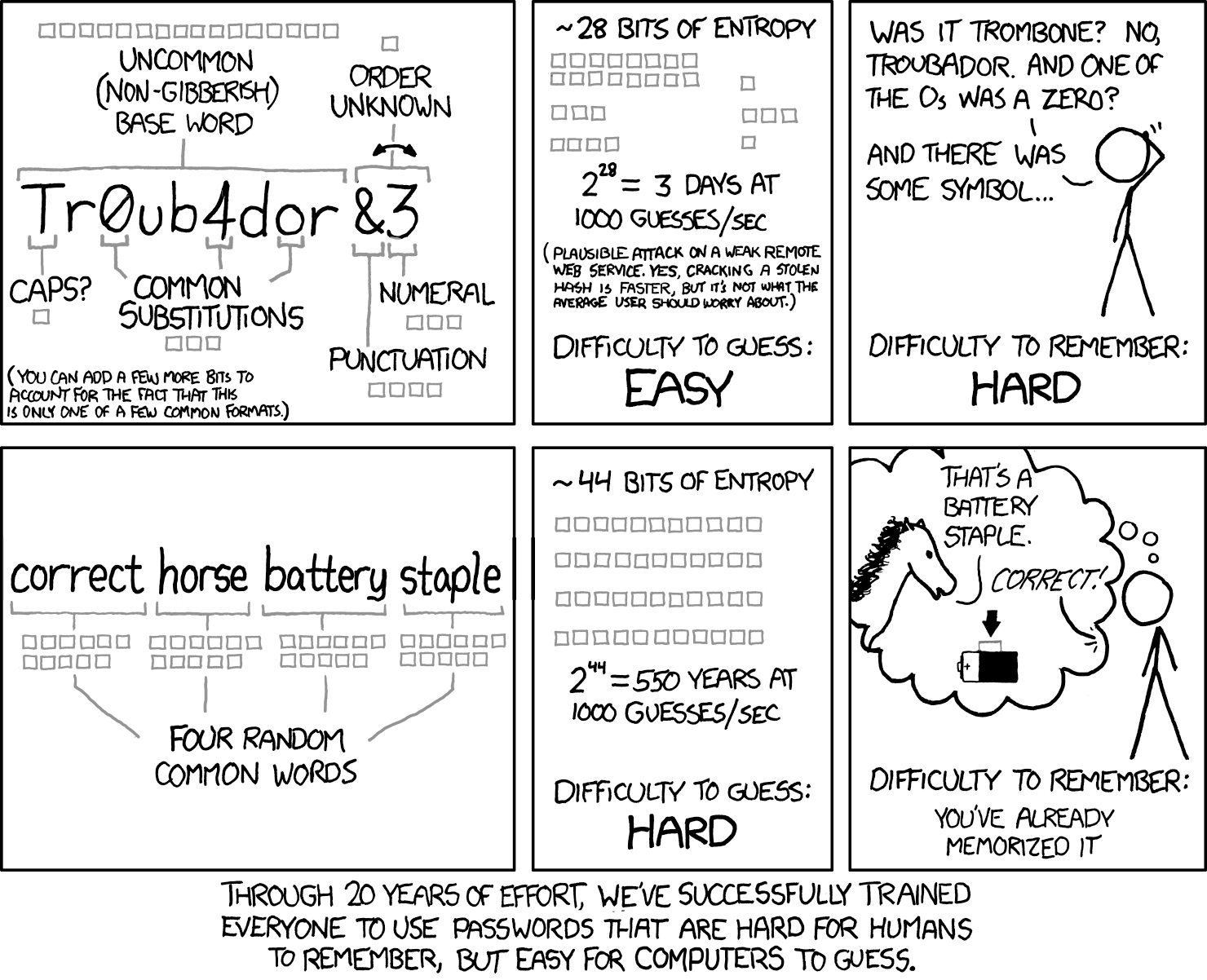
The practical takeaway: a 12-character all-lowercase password drawn randomly from 26 characters has more real entropy than an 8-character "complex" password a human actually chooses, because humans are predictable and mathematics is not.
Length scales entropy exponentially with each additional character. Composition rules add a small, easily-guessed search space on top of a short string. Against modern GPU hash rates, that difference determines whether a brute force attack takes hours or centuries.
How to move away from complexity rules
Moving off legacy complexity rules doesn't require a multi-quarter project. Most of the work is policy and configuration, not new infrastructure, and it maps closely to what NIST SP 800-63B-4 and the OWASP Authentication Cheat Sheet both recommend: update the password policy document, adjust the identity provider's settings, and give users a grace period to update existing passwords at next login.
The 5-step complexity rule migration checklist:
- Update the written policy first. Replace character-composition requirements with a minimum length of 15 characters, generated at random rather than composed by hand. Drop mandatory digit, symbol, and uppercase rules, along with periodic forced resets, both add friction without a corresponding security gain once minimum length is enforced.
- Reconfigure the identity provider. Most AD/LDAP and SSO systems let you disable complexity enforcement and set a minimum length independently. Test the change on a pilot group before rolling out organization-wide.
- Add breach-database screening. Check new passwords against known-breached password lists at creation time. This does more to stop credential stuffing than forcing a digit and a symbol, because it blocks the exact passwords attackers are already trying, not just weak patterns.
- Deploy phishing-resistant MFA. A long, unbreached password is still a single point of failure if it gets phished. Prioritize FIDO2/WebAuthn security keys or passkeys for production access. TOTP works as a fallback, but security keys and passkeys should be the goal.
- Give a grace period, not a forced reset. Force everyone to change passwords on the same day and you get a flood of
Winter2026!-style patterns. Let passwords rotate naturally at next login or expiration instead.
Teams that make this switch tend to see a secondary benefit nobody puts in the policy document: helpdesk ticket volume for password resets drops, because there's no forced rotation cycle generating "I forgot my new password" tickets every quarter.
For service accounts and secrets that can't rely on human memory at all, the calculus is different: generated 32+ character secrets stored in a password manager rather than something anyone types from memory.
Why MFA and passkeys are the real endgame
Even a well-designed password policy is a transitional measure. The direction security is heading is passwordless authentication built on FIDO2 and WebAuthn, where there's no shared secret to steal in the first place.
Passkeys are phishing-resistant by design: the private key never leaves the device, and the relying party stores only a public key that has no value to an attacker without the matching hardware. Apple, Google, and Microsoft support passkeys natively across their platforms, per the W3C WebAuthn specification, and consumer adoption has moved faster than most predicted.
Enterprise adoption runs on a slower timeline. Three factors keep most organizations years away from retiring passwords entirely:
- Legacy applications that authenticate against on-prem directories or predate WebAuthn support and can't be rewritten overnight
- Federated identity setups where SSO, SAML, and LDAP integrations need to accommodate passkeys alongside existing protocols, not replace them outright
- Workforce-scale rollout logistics: device enrollment, account recovery when a hardware key is lost, and help desk capacity to support the transition
In that window, the password policy described above (length, breach screening, MFA) enforced through tooling rather than a PDF is what keeps an organization secure while the transition plays out.
What a password manager enforces that Group Policy cannot
A Group Policy Object defines password composition rules, but has no way to check whether a password has already leaked, and no mechanism for tracking who accessed a shared credential afterward. A password manager closes that gap: it screens credentials against breach databases, enforces length organization-wide, and logs every access event. That's the enforcement layer GPO structurally lacks.
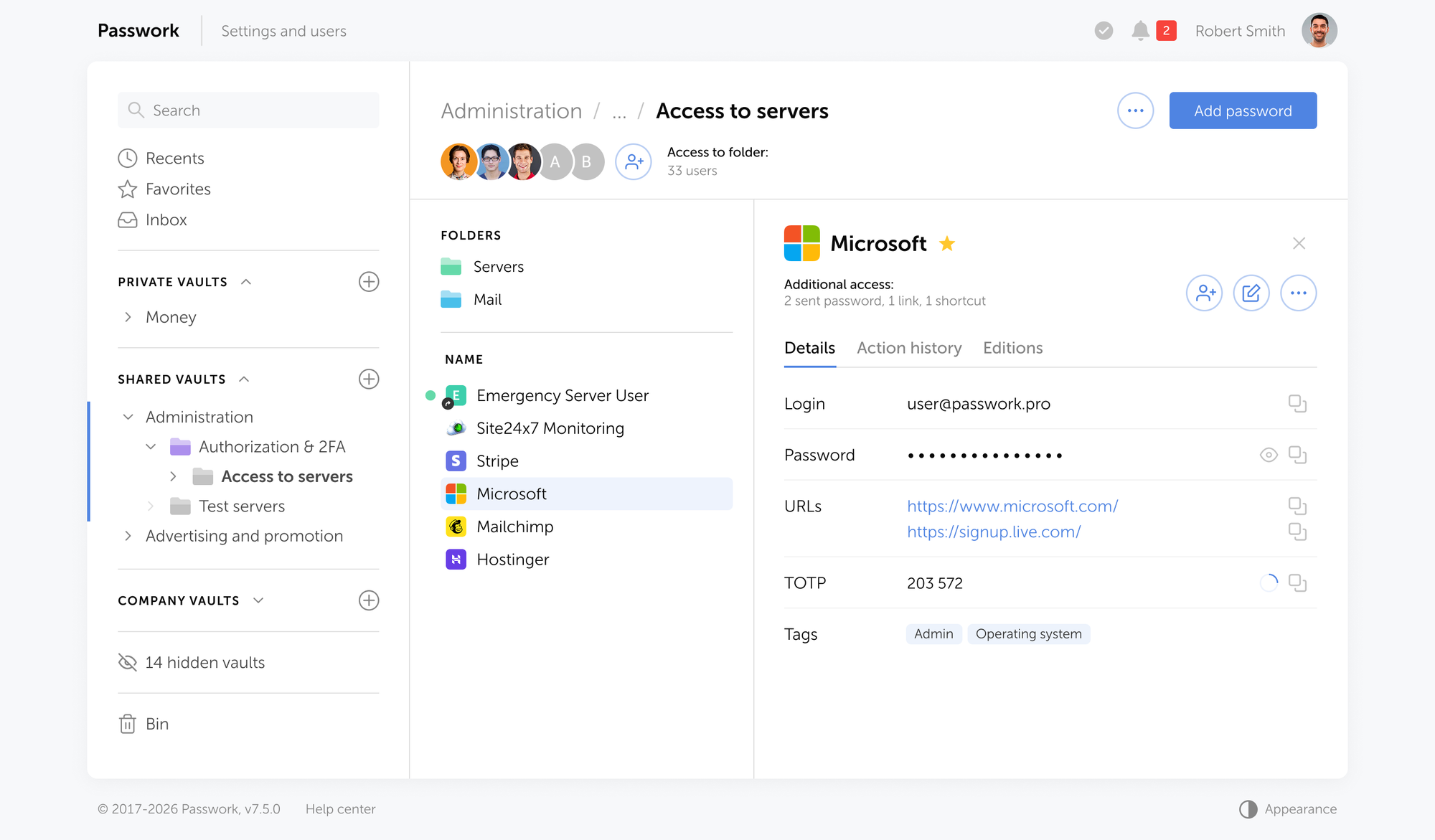
Passwork, a self-hosted corporate password manager, applies this at the vault level: it enforces minimum length organization-wide without reintroducing character-mix rules, and organizes team credentials into shared vaults with role-based access control that scopes permissions by group instead of by individual account.
Passwork's built-in generator produces cryptographically random, high-entropy passwords, the kind a person cannot reliably invent by hand, and stores them directly in the vault. Autofill then handles login, so no one ever has to memorize or retype what the generator created. That removes the last point where a human could still weaken the password: the moment someone tries to make a long, random string memorable and quietly makes it predictable instead.
Unlike tools that handle only human logins, Passwork combines password management and secrets management in one vault: API keys, access tokens, database credentials, and TLS certificates sit alongside user passwords under the same access controls and audit log.
Making the switch
Complexity rules are a holdover from an era when attackers relied on brute-force guessing rather than automated tooling. Once credential-stuffing attacks can test thousands of password variants per second, asking users to invent entropy manually stops making sense. Length and MFA do the job composition rules were supposed to do, without relying on anyone's memory.
The NIST update is a formal acknowledgment of something security practitioners have watched happen for over a decade: humans are the weakest link in any policy that asks them to generate randomness on demand.
Start with the audit. Pull your current GPO password settings, check whether they still mandate composition and rotation, and map that against SP 800-63B-4.
Frequently asked questions
Does NIST apply to my organization if I am not a US federal agency?
NIST SP 800-63 is the de facto global standard for password policy even outside federal requirements. OWASP's Authentication Cheat Sheet draws directly from it, and national bodies including Germany's BSI and France's ANSSI are progressively aligning their own recommendations with the same principles.
What is the minimum password length NIST recommends now?
NIST SP 800-63B-4 sets 8 characters as the absolute minimum for passwords used alongside multi-factor authentication. If a password is the only security control (no MFA), systems must require a minimum of 15 characters. In practice, most enterprise teams should treat 12 or more characters as the realistic working floor, since 8 characters alone offers little margin against current cracking hardware even with MFA in place.
Should I still enforce periodic password changes?
No. NIST SP 800-63B-4 explicitly drops mandatory rotation. Change a password only when there is evidence of compromise, such as a breach database match or a suspicious login, or when the user requests it themselves.
Do passkeys replace passwords entirely?
Not yet, and not soon for most environments. Passkeys are the long-term direction, but adoption is gradual due to legacy systems and rollout complexity. Password managers bridge that gap by handling password hygiene, breach screening, and access control today.
How do I check if a password has been breached without exposing it?
Use the Have I Been Pwned k-anonymity API. The password gets hashed client-side with SHA-1, and only the first five characters of the hash are transmitted to the service. The full password and the complete hash never travel over the network.
 Alex Muntyan
 Passwork Team
 Alex Muntyan
Table of contents
- Six things to fix before you close this tab
- What are password complexity rules
- What NIST changed — and why it matters
- The behavioral failure of complexity rules
- Length and randomness beat complexity — the math
- How to move away from complexity rules
- Why MFA and passkeys are the real endgame
- What a password manager enforces that Group Policy cannot
- Making the switch
- Frequently asked questions
Table of contents
- Six things to fix before you close this tab
- What are password complexity rules
- What NIST changed — and why it matters
- The behavioral failure of complexity rules
- Length and randomness beat complexity — the math
- How to move away from complexity rules
- Why MFA and passkeys are the real endgame
- What a password manager enforces that Group Policy cannot
- Making the switch
- Frequently asked questions

Self-hosted password manager for business
Passwork provides an advantage of effective teamwork with corporate passwords in a totally safe environment. Double encryption and zero-knowledge architecture ensure your passwords never leave your infrastructure.
Learn more