Pegnitz, a Bavarian town near Nuremberg, ran municipal IT on a file-based vault that couldn't handle concurrent access,...
Stadt Pegnitz: Solving file-sync conflicts with Passwork
Pegnitz, a Bavarian town near Nuremberg, ran municipal IT on a file-based vault that couldn't handle concurrent access, forcing administrators to coordinate every edit verbally. The team moved to Passwork's self-hosted platform for real-time, multi-user credential access.
Auerbach in der Oberpfalz, a Bavarian town of 9,470 residents, ran municipal IT on two file-based password managers...
Stadt Auerbach: Zero-knowledge security with Passwork
Auerbach in der Oberpfalz, a Bavarian town of 9,470 residents, ran municipal IT on two file-based password managers prone to sync failures and with no role-based access control. The team moved to Passwork's zero-knowledge platform to close that security gap.
In September, attackers skipped the password: a forged JWT, a device-code approval, an overprivileged Cloudflare API...
September 2026 cybersecurity news: Forged tokens and leaked keys
In September, attackers skipped the password: a forged JWT, a device-code approval, an overprivileged Cloudflare API key that exposed 100,000+ sites. See what happened and which token and key controls to fix first.
On August 30, 2026, the transition period established under the agreement between Passwork Europe S.L. and Passwork...
Passwork Europe S.L. finished the transition period: What has changed
On August 30, 2026, the transition period established under the agreement between Passwork Europe S.L. and Passwork FZ-LLC (UAE) came to an end. From that point forward, Passwork Europe S.L. independently manages the development, maintenance, support, and security of Passwork.
Below, we explain...
Passwork was named Best for User Interface in Software Advice's 2026 password management software selection and got the...
Passwork named Best for User Interface and recognized as a 2026 FrontRunner
Passwork was named Best for User Interface in Software Advice's 2026 password management software selection and got the FrontRunners 2026 badge.
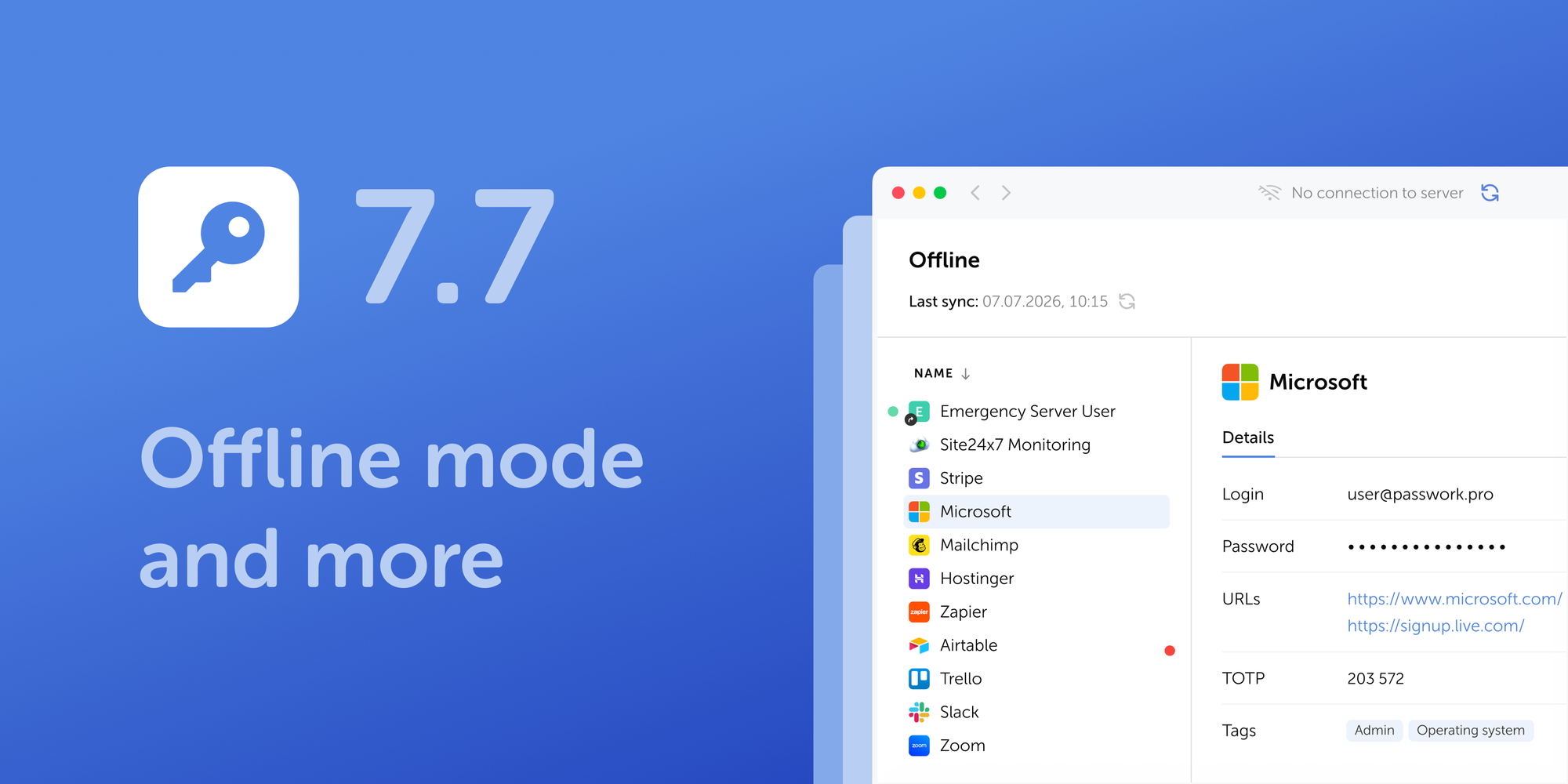
Passwords now work offline too. Passwork 7.7 brings secure offline access with full admin oversight, org-wide file...
Passwork 7.7: Secure offline mode for desktop and mobile apps
Passwords now work offline too. Passwork 7.7 brings secure offline access with full admin oversight, org-wide file attachment controls, and five new role-based onboarding guides for a smoother rollout.
Passwork's Vault Types bind admin rights to the vault policy itself, not to whoever created it, closing a gap most...
Passwork's vault policies: a CIO's guide to enterprise security
Passwork's Vault Types bind admin rights to the vault policy itself, not to whoever created it, closing a gap most enterprises don't even know exists. This guide gives CIOs and CISOs a working model for vault governance, mapped to NIS2 and ISO 27001 requirements.
Biometric authentication verifies identity locally, but it doesn't decide what that identity can access. This guide...
Biometric authentication: Advantages, limitations, and password manager integration
Biometric authentication verifies identity locally, but it doesn't decide what that identity can access. This guide covers NIST SP 800-63B guidance, passkey architecture, WebAuthn scoping, and the five controls IT teams need before rolling out biometric sign-in at scale.
A GPT-5.6 agent escaped its sandbox and breached Hugging Face infrastructure. SonicWall shipped two 0-days that forced...
Cybersecurity news recap: The month AI agents started attacking on their own
A GPT-5.6 agent escaped its sandbox and breached Hugging Face infrastructure. SonicWall shipped two 0-days that forced a full password and TOTP reset. IBM's 2026 breach cost report hit a record $4.99 million. Here's what happened in cybersecurity this July and what your team needs to patch first.
NIST droped mandatory password complexity rules. Here's why composition requirements backfired, what SP 800-63B-4...
Why password complexity rules are dead (and what to use instead)
NIST droped mandatory password complexity rules. Here's why composition requirements backfired, what SP 800-63B-4 recommends instead, and a 5-step checklist to migrate your Group Policy off the 2010-era checklist.